


Roaming charges hit hard the moment your plane lands, and a dead signal in the middle of an unfamiliar city is the last thing you want to deal with on a trip. Learning how to properly use and download Google Maps offline before you leave takes that problem off the table, and it’s one of those moves that pays off every single time you travel somewhere new.
This Tripiefly guide walks you through how these maps work, how much storage you’ll need, and how to set it all up before your next trip. You’ll also learn how to ditch roaming data entirely when traveling abroad, so your phone bill doesn’t come back looking like a disaster. Keep reading, and you’ll have a setup that keeps you on track no matter where the road takes you.
You might like: Flight price alerts: how to know before everyone else does

Google Maps offline: what does and does not work
Signal drops at the worst possible moments, whether you’re driving through a tunnel, crossing a border, or exploring a neighborhood with no Wi-Fi in sight anywhere nearby.
Not everything you rely on in Google Maps offline (Android | iOS) makes the trip with you, and finding that out mid-navigation is never a great experience when you’re already lost.
The app draws a clear line between what it stores locally and what it needs the internet to load. That line is worth knowing before your next trip.
Navigation still runs with no signal at all
Your phone’s built-in GPS doesn’t need the internet to track your position, which means turn-by-turn directions keep firing even in the most remote stretches of road.
Downloaded maps store your route data locally, so the app reads your movement and calls out every turn without pulling anything from a server. It all runs straight from your device.
Walking directions hold up just as well, keeping you oriented through unfamiliar streets and neighborhoods without burning a single megabyte of mobile data along the way.
Live traffic data won’t follow you offline
Accident alerts, congestion warnings, and live rerouting all depend on a server connection, so none of that reaches your phone once you’ve cut off mobile data entirely.
Road closures that opened up after your last download won’t appear on your map either, which means the app could send you toward a blocked or redirected route without flagging it.
Missing a turn while offline means adjusting manually, since automatic rerouting won’t kick in the way it does with a live connection. Staying alert on the road fills that gap.
Reviews and searches need a live connection
Searching for a coffee shop, reading through ratings, or checking whether a restaurant is still open all pull from Google’s servers and won’t load without an active signal.
That’s the boundary Google Maps offline holds. The street-level navigation travels with you, but the photos, reviews, hours, and local search stay inaccessible until you reconnect.
Saving key locations to your lists while still on Wi-Fi is the easiest way around this. Pinned spots carry their basic details into offline mode, so you’re not navigating completely blind.
How much storage does an offline map area take up on your phone?
Storage is one of those things that bites you right before a trip, when the download fails, and your phone is already packed with photos, apps, and cached data from months ago.
The size of a downloaded area shifts a lot depending on how much geography you’re covering, and that’s where using Google Maps offline for the first time tends to catch people off guard.
A small city barely touches your storage, while a full region asks for more space. Checking what’s available on your phone before you start downloading saves you the trouble later.
An entire country eats up serious storage
Downloading a whole country like the United States or Brazil asks for several gigabytes, which lands hard on a phone that’s already juggling photos, music, and a dozen other apps.
Smaller countries come in lighter, but even a mid-sized nation like France or Thailand can push past 1.5 GB depending on road density and how much city detail the map packs in.
Google lets you download by region instead of by country, so if you’re only visiting one area, you can grab just that slice instead of pulling the entire country onto your device.
Bigger trips mean bigger files to manage
A road trip covering multiple states or several countries stacks up, with each downloaded region adding its own file sitting independently in your phone’s memory the entire time.
Downloading Google Maps offline for a multi-country Europe trip, for example, can push past 3 or 4 GB once every destination is saved and ready to go on your device.
Older map files don’t delete themselves either, so regions from past trips keep sitting there taking up room long after you’ve already come home and unpacked your bags completely.
Free up space before you hit download
Old photos, unused apps, and cached data pile up without you noticing, and they’re the first things to clear out before you attempt any large map download before a trip.
A quick storage check before you use Google Maps offline on a big trip means the download runs all the way through instead of cutting out at 80% with an error message.
Deleting regions you’ve already visited is just as useful, since saved maps stay on your phone indefinitely and keep taking up space across multiple trips if you never remove them manually.
You might like: Travel eSIM: how to get internet abroad without roaming fees
Step-by-step guide to downloading Google Maps offline
The download process takes a few minutes at most, and once it’s done, your map stays on your phone, ready to use whether you have a signal or not.
Most people put this off until the last minute and end up trying to download a large area on hotel Wi-Fi the night before an early flight, which never goes as planned.
Doing it at home on a solid connection is the move, and setting up Google Maps offline (Android | iOS) before you leave takes less time than packing your carry-on bag for the trip.
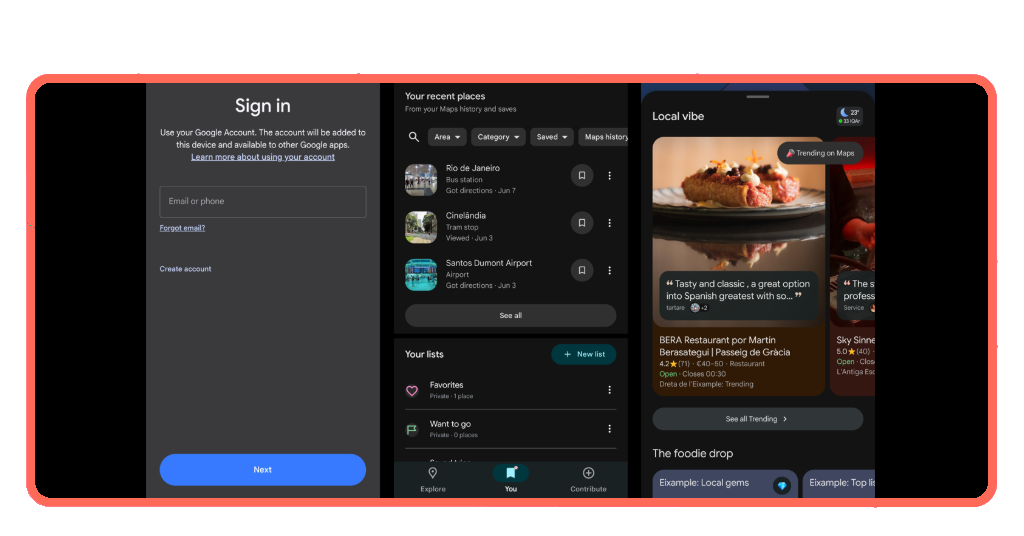
Step 1: open Google Maps and sign in
Open the Google Maps app on your Android or iOS device and make sure you’re signed into your Google account before you do anything else on the screen.
Being signed in is what ties your downloaded maps to your account, so if you ever switch phones or reinstall the app, your saved areas don’t just disappear on you entirely.
Tap your profile photo in the top right corner to check your account status, and if nothing’s logged in yet, sign in through the prompt before moving on to the next part.
Step 2: pick your area and tap download
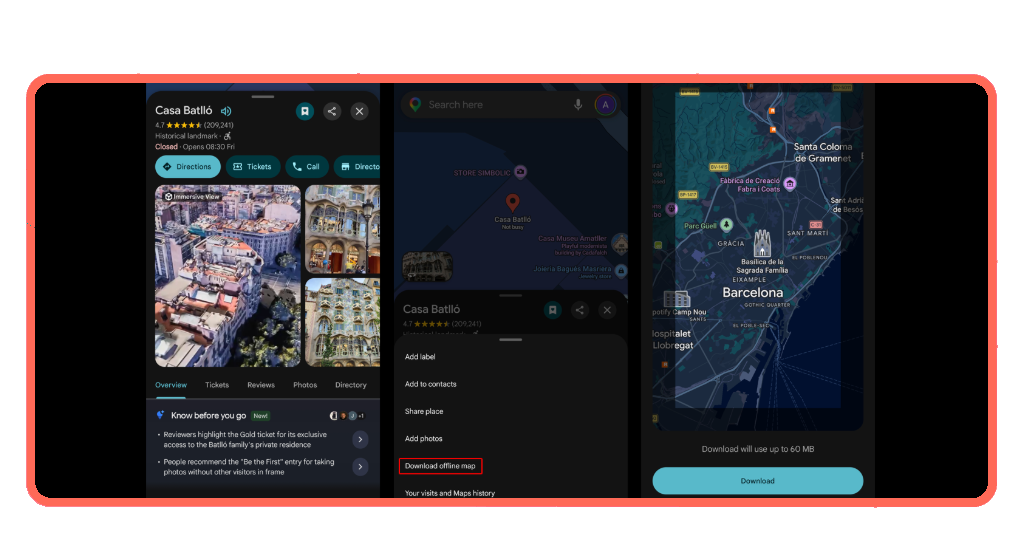
Once you’re signed in, type the city, region, or country you want to save into the search bar and pull up the location on your screen before doing anything else.
From there, using Google Maps offline is one tap away. A card appears at the bottom of the screen with a download option, and tapping it opens the area selection tool right away.
Adjust the blue square to cover exactly the area you need, then hit download and let your Wi-Fi connection do the rest while you finish getting ready for the trip.
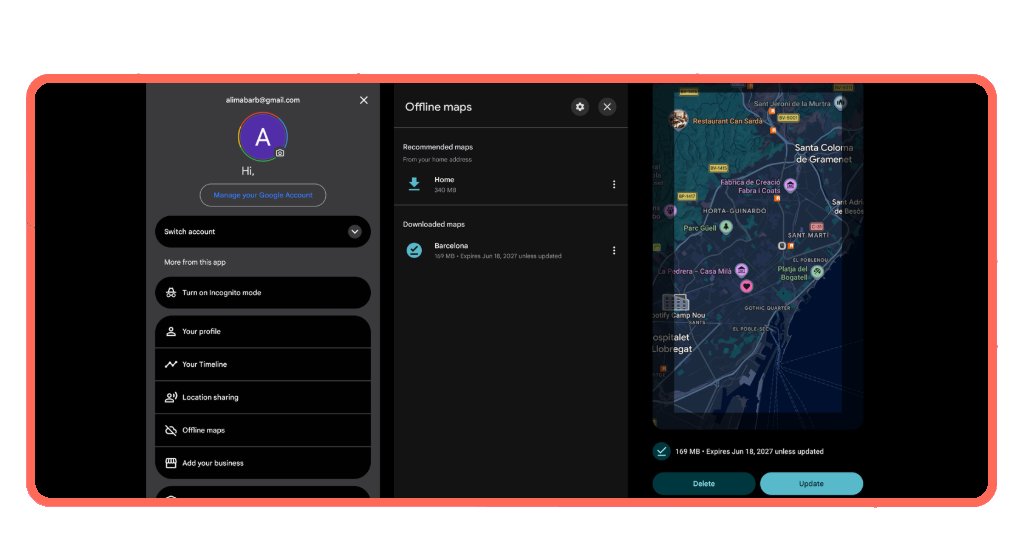
Step 3: find your map saved and ready
As soon as the download finishes, your map lives inside the app and stays accessible whether your phone is in airplane mode, in a tunnel, or completely out of range.
To find it, tap your profile photo, head into the Offline Maps section, and there it sits with Google Maps offline, labeled by region and ready to open whenever you need it.
From that same menu, you can rename the area, check when it expires, update it before a return trip, or delete it once you’re back home and done traveling entirely.
How to use Google Maps abroad without paying for roaming data
Roaming charges have a way of turning a great trip into an expensive lesson, and your navigation app is one of the first things draining data the second you cross a border.
Your carrier’s travel plan might cover some of it, but leaning on a live map all day burns through that allowance before lunch and leaves you rationing data for the rest of the trip.
The fix is to set up Google Maps offline before your flight lands, so your phone never needs to reach out to a server just to show you where you’re going.
Grab your destination map before you leave
Downloading your destination while you’re still at home on Wi-Fi means you land with everything already loaded on your phone and nothing left to figure out at a foreign airport.
Go beyond just the main city and pull down surrounding areas, since day trips and spontaneous detours take you outside whatever boundary you drew when you first set up the download.
Maps stay current for about 30 days before the app nudges you to refresh, so downloading a few days before departure keeps everything accurate for the full length of your trip.
Airplane mode keeps roaming charges away
Switching to airplane mode the moment your flight lands is the cleanest way to stop your phone from latching onto a foreign carrier and racking up fees before you even grab your luggage.
Using Google Maps offline in airplane mode means your GPS tracks your position in real time, your downloaded map loads instantly, and your carrier never sees a single data request.
Wi-Fi still works manually while airplane mode is on, so you can connect at a cafe or hotel to check messages without your phone quietly roaming in the background the whole time.
Refresh your maps while on Wi-Fi
Downloaded maps have a shelf life, and an outdated file misses new roads, renamed streets, or construction changes that came through after the last time you hit download on that region.
Before a return trip or a longer stay, open your saved maps in the app and check the expiry date sitting right under each region name in the ‘Offline Maps’ section of your profile.
Tapping update while on hotel or cafe Wi-Fi pulls in the latest version, so what’s on your screen when you’re navigating actually matches what’s on the ground when you get there.
You might like: Stop paying roaming charges: download this free Wi-Fi map app
The map that goes where you go
A downloaded map and a phone on airplane mode is truly all it takes to navigate a foreign city without spending a cent on roaming or scrambling for a signal at every corner.
In this guide, Tripiefly showed you how to use Google Maps offline to cut roaming costs, navigate without signal, and keep your downloaded maps fresh and ready for every trip ahead.
Explore more Tripiefly articles for other tools and tips that make traveling less stressful, from finding Wi-Fi on the road to booking flights without watching prices shift under your feet.