


Nothing puts a dent in vacation excitement quite like realizing you’re paying far more than expected every time you use your money abroad. That’s why understanding currency exchange is one of the smartest travel skills you can develop. You don’t need to be a finance expert, but knowing how exchange rates, fees, and markups work can help you keep more of your travel budget where it belongs: funding your trip, not padding someone else’s profits.
The challenge is that currency exchange costs are often easy to miss. Whether it’s an airport kiosk, a bank card fee, or a ‘convenient’ conversion offer, those extra charges can add up quickly. That’s why many travelers now rely on digital banking tools and travel-friendly apps to keep more of their money where it belongs: in their vacation budget. Read ahead on Tripiefly.

Currency exchange rates abroad: why do they vary so much?
Why are currency exchange rates so wildly inconsistent across a single city?
The answer lies in a clever industry secret: the difference between the ‘mid-market rate’ and the ‘retail rate.’ The mid-market rate is the real valuation of a currency—the price banks use to trade with one another.
When you purchase local currency, retail providers tack on a massive spread. This spread is a hidden premium added to the conversion rate, allowing businesses to advertise ‘zero commission’ while pocketing a massive cut of your cash.
Airport kiosk, hotel reception and bank ATM: how to compare rates
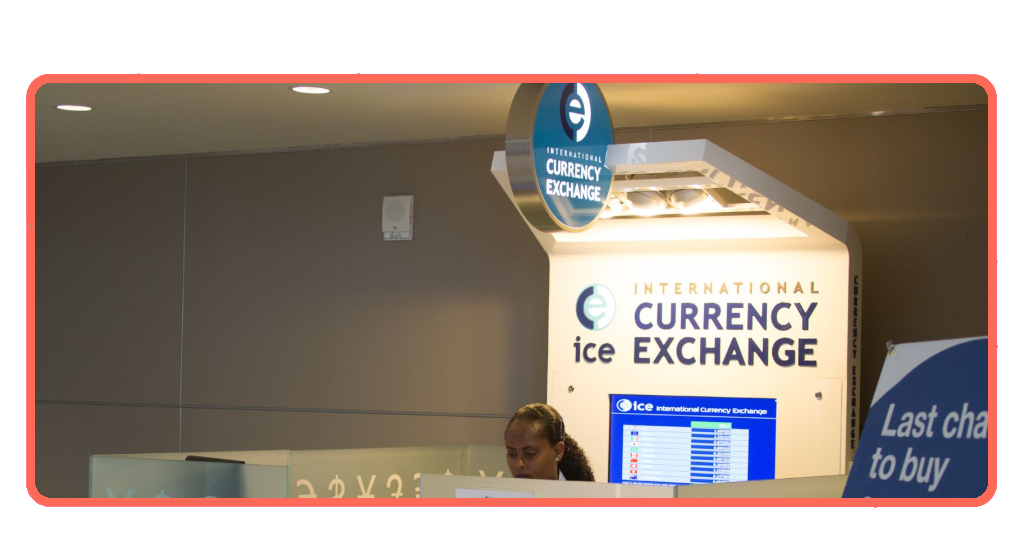
Airport exchange kiosks are convenient, but that convenience often comes at a steep price.
Located in airports where travelers are tired, rushed, and in immediate need of local cash, these counters can offer some of the least favorable currency exchange rates available.
In some cases, the difference can cost you up to 15% more compared to what you’d get through a bank or travel-friendly financial service and that’s why seasoned travelers usually avoid exchanging large amounts of money at the airport.
Then there are hotel receptions, which are marginally better but still represent daylight robbery, as they operate on outdated manual ledger rates updated once a day at their convenience.
ATMs should be your safest bet, but they are increasingly infected with a trap that goes by the name of Dynamic Currency Conversion (DCC).
When a foreign machine asks if you would prefer to be billed in your ‘home currency’ rather than the local tender, the machine is asking for permission to execute a unfavorable conversion on your behalf.
Always choose the local currency option to force your home bank to handle the transaction math fairly.
Step-by-step guide to exchanging currency abroad
Between hidden fees, exchange counters, and shifting rates, exchanging money abroad isn’t always that simple—but that doesn’t mean you can’t avoid common traps.
Step 1: check the exchange rate before you travel
A few days before departure, look up the current exchange rate for your destination’s currency.
Step 2: avoid exchanging large amounts at the airport
If you need local cash immediately, exchange only a small amount and wait until you can access a bank, ATM, or more competitive provider.
Step 3: use a travel-friendly debit or credit card
Many modern banks and fintech apps offer lower foreign transaction fees and exchange rates that are much closer to the market rate. Before your trip, check whether your card charges extra fees for international purchases.
Step 4: choose the local currency at checkout
When paying abroad, card terminals may ask whether you want to be charged in your home currency or the local currency. In most cases, selecting the local currency helps you avoid expensive dynamic currency conversion fees.
Step 5: withdraw cash strategically
Instead of making several small ATM withdrawals, consider taking out larger amounts less frequently, which can help reduce the impact of fixed withdrawal fees charged by banks and ATM operators.
Step 6: keep an eye on hidden charges
Exchange rates tell only part of the story. Service fees, ATM surcharges, and foreign transaction fees can increase your costs, so always review the final amount before confirming a transaction.
Step 7: save your receipts and transaction records
Keeping a record of exchanges and withdrawals makes it easier to track your travel spending and resolve any unexpected issues with your bank after the trip.
To avoid making these common mistakes, review some of HSBC’s International FX Tips.
The best cards and apps for spending abroad with the lowest fees
Modern fintech has made currency exchange a lot less painful for everyday travelers.
Wise (iOS | Android) is one of the best-known options in that space, built to make international money management more transparent and easier to use.
With the mid-market rate and clear upfront fees, it can cost far less than many traditional banks.
In some cases, travelers can save up to 8x compared with old-school bank exchange rates, and the app makes it easy to manage money while you’re on the move.
To understand how to avoid hidden ATM fees while using these digital alternatives, you can check out the Wise ATM Guide to keep your physical withdrawals optimized.
How much cash to take abroad
When figuring out how much cash to bring, don’t let the fear of currency exchange force you into hoarding huge paper stacks.
In 2026, card payments and digital wallets dominate daily life in many destinations, from London and Singapore to Tokyo and Amsterdam.
In fact, several European countries now report that most in-person purchases are made electronically.
Carrying too much cash not only increases the risk of loss or theft but also leaves you vulnerable to poor exchange rates if you convert more money than you actually need.
That said, going completely cash-free isn’t always the smartest move either. Street markets, local cafés, public transportation systems, and small family-run businesses may still prefer cash, especially outside major tourist hubs.
A practical rule is to carry enough local currency to cover one or two days of small expenses, plus a little extra for emergencies.
For most travelers, that usually means the equivalent of $ 100.00 to $ 300.00, depending on the destination and length of stay—think of cash as your backup singer, not the lead performer of your travel budget.
The rest of your budget can stay safely on a travel-friendly debit or credit card, ready to be accessed when needed.
Don’t let bad exchange rates crash your vacation budget
A great trip can be filled with unforgettable meals, beautiful views, and amazing experiences. What most travelers don’t want to remember is how much money disappeared because of avoidable currency exchange fees.
Those small charges may seem harmless, but over time they can take a bigger bite out of your budget than expected.
Fortunately, a few smart habits can help you stay ahead of the game. Compare rates before exchanging money, be cautious with airport kiosks and ATM conversion offers, and consider using travel-friendly financial apps.
Your future self will thank you when there’s more money left for souvenirs, activities, or one extra dessert that wasn’t in the original budget.