


Staring at flight prices to somewhere like Barcelona will ruin your good mood the second the final total pops up on the screen. The airfare alone eats up your entire vacation fund before a single hotel room is booked, leaving those travel plans stuck in a group chat permanently. Diving into airline miles for beginners opens a different route to cover those flights using everyday purchases instead of cash.
Covering groceries or a monthly phone bill through a specific loyalty program turns those expenses into a valid boarding pass. In this guide by Tripiefly, we’ll take a look at the top reward programs to join and highlight the daily habits you need to start building a significant points balance. Keep reading, and you will uncover the steps to transform your routine weekly spending into a free flight for your next vacation.
You might like: Get VIP airport lounge access: discover how with Priority Pass
Best Airline Miles programs for beginners
Not every loyalty program delivers the same value, and for anyone exploring the best airline miles for beginners options, the differences between them genuinely change what’s reachable.
Some programs reward the distance a flight covers, while others calculate points based on how much the ticket costs, and that distinction affects how quickly a balance grows.
Expiration policies, partner networks, and redemption flexibility all vary across programs, so picking one that lines up with real habits and travel goals makes the whole process work harder.
Programs with no mileage expiration
- Atmos Rewards: this program covers over 1,200 global destinations through the Oneworld Alliance and lets members choose how they want to earn;
- Delta SkyMiles: members get access to dynamic award pricing with no blackout dates, meaning available seats on any flight are always fair game;
- United MileagePlus: this program connects members to over 1,290 destinations through the Star Alliance network, with award flights starting as low as 4,500 miles;
- Southwest Rapid Rewards: points go toward the Companion Pass, one of the most practical perks in domestic travel, letting a designated person fly for taxes and fees only;
- JetBlue TrueBlue: pools points across family members in the same account, and the program partners with major transferable rewards currencies for faster balance building.
Tips on how to easily accumulate miles
Racking up a solid balance without flying every weekend is completely doable, and the airline miles for beginners‘ journeys get a lot more interesting once non-flight earnings enter the picture.
Dining programs, shopping portals, and co-branded card bonuses all feed into the same loyalty account, turning purchases that were already happening into something that moves the needle.
The trick is making sure every dollar spent is working toward a specific program rather than scattered across too many accounts where nothing ever reaches a useful redemption threshold.
Sign up for airline dining rewards
Most major airlines run a dining rewards program that deposits miles directly into a loyalty account every time a registered card is used at a participating restaurant.
Registration takes a few minutes online, and after that, the miles come in automatically with no extra steps required beyond eating at places already on the regular rotation.
Time big purchases to card applications
A new card’s sign-up bonus delivers a large chunk of miles fast, and timing the application around a planned expense makes hitting the minimum spend feel completely effortless.
Covering a home repair or a seasonal expense during the first few months of card ownership is a move that airline miles for beginners guides rarely spell out clearly enough.
Shop through airline online portals
Every major loyalty program runs a shopping portal where clicking through before checkout at retailers like Target or Best Buy earns extra miles on top of card rewards.
The portal requires nothing beyond logging in before heading to a retailer’s website, and those bonus miles stack directly onto the base earning rate without any additional cost.
You might like: Unsold airline seats: download this app for 70% off tickets
Can you earn miles without a travel credit card?
A travel credit card is the route most people hear about first, but it’s far from the only way to build a miles balance worth redeeming for a real trip.
Debit cards tied to specific airlines, loyalty program sign-ups, and referral incentives all create earning opportunities that don’t require a credit application or a hard pull on a credit report.
Plenty of people build toward a free flight through airline miles for beginners strategies never open a travel credit card at all, and their balances grow just the same.
Travel debit cards that earn rewards
Some airlines and hotel brands offer debit cards that deposit rewards directly into a linked loyalty account, and the earning structure works similarly to what a basic credit card provides.
Southwest, United, and Wyndham all have debit card options that require a minimum balance or deposit, but the miles earned on transactions flow into the same account as flight rewards.
Loyalty programs alone go a long way
Signing up for a free loyalty program and crediting every flight to that account costs nothing and sets up a foundation that every other earning method builds directly on top of.
Programs like Delta SkyMiles also let members earn through dining partnerships, online shopping portals, and survey incentives without ever swiping a credit card to trigger the reward.
Referral bonuses add up over time
Airline loyalty programs pay out miles when an existing member refers someone new, and those bonuses land in the account once the referred person completes their sign-up process.
Referring a friend or family member who’s also figuring out airline miles for beginners means both accounts grow at the same time without either person spending an extra dollar.
Step-by-step guide to joining miles programs
Joining a miles program online doesn’t take too much of your time, and the whole process from picking a program to earning a first flight wraps up in under half an hour.
For this example, we’ll use Atmos Rewards, the joint loyalty program for Alaska and Hawaiian Airlines that consistently ranks as one of the most rewarding options for new members.
Spreading a balance thin across multiple programs at once is the fastest way to end up with no redemptions, which is the mistake most people diving into airline miles for beginners make first.
Step 1: pick one program to focus on
The home airport is the best starting point here, since the airline with the most routes out of a familiar city will generate earning opportunities on a regular basis.
Atmos Rewards covers over 30 global partners and oneworld Alliance members, making it a program that delivers a real range even for someone who flies domestically most of the time.

Step 2: sign up and book your first flight
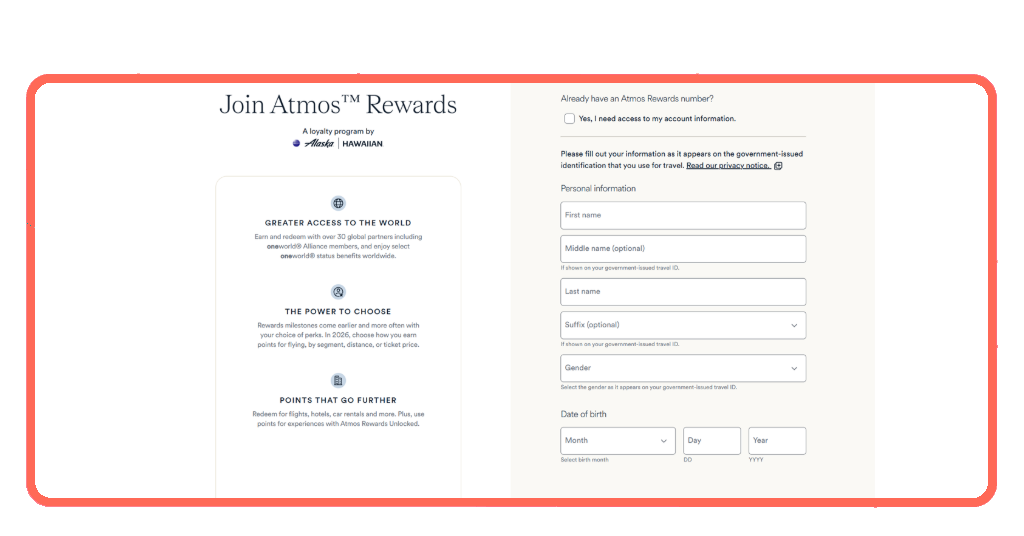
The Atmos Rewards registration form asks for a legal name as it appears on your travel ID, a date of birth, gender, and basic contact information, including a phone number.
Once the account is live, the membership number appears immediately in the profile and gets added to any upcoming flight reservation before the booking is confirmed and paid for.
Step 3: add your number to every booking
A frequent flyer number left off a reservation means the miles from that flight are gone, and retroactive credit requests don’t always go through without the original boarding pass as proof.
Saving the number in a phone’s notes app keeps it ready for every booking, and you’ll find out pretty quickly that missed credits are the most avoidable loss in the airline miles for beginners process.
You might like: Best eSIM for Europe: guarantee good phone coverage with Holafly
How airline partners help you earn more miles
Loyalty programs don’t just reward the flights you take on a single airline, and the partner network sitting behind most programs is where a balance really picks up speed.
Booking a flight on a partner carrier, transferring hotel points, or tapping into an alliance network all feed into the same loyalty account without requiring a separate sign-up for anything.
The partner ecosystem is one of the most underused advantages in the whole space, and wrapping your head around it is what takes airline miles for beginners from slow to productive.
Flying partner airlines still counts
Atmos Rewards lets members credit miles to their account when flying on any oneworld Alliance carrier, so a ticket booked on Japan Airlines or British Airways still grows the same balance.
The key is selecting Atmos Rewards as the frequent flyer program during booking, since the miles won’t transfer automatically without that number attached to the reservation before the flight.
Hotel points transfer to airline miles
Marriott Bonvoy points transfer to some airline programs, including American AAdvantage, and every 3 points converts to 1 airline mile, with a 5,000-mile bonus added per 60,000 points.
Bilt Rewards is another option worth looking into, since it lets members earn points on rent payments and transfer those points to airlines like United, American, and Alaska at a 1:1 rate.
Alliance networks expand your reach
Star Alliance, oneworld, and SkyTeam each connect dozens of airlines under a shared earning structure, and seeing how they work is a turning point in mastering airline miles for beginners.
United MileagePlus sits inside Star Alliance with access to over 1,290 destinations, meaning a single loyalty account opens up award redemptions on routes that United doesn’t work directly.
Airline miles: when points are actually worth using
Having a miles balance sitting in an account feels good until it becomes clear that redeeming it at the wrong time or on the wrong ticket cuts the value in half.
Not every redemption delivers the same return, and the difference between a strong use of points and a poor one comes down to knowing what each mile is actually covering.
The redemption decision is where airline miles for beginners either pay off or disappoint, so picking the right moment and the right ticket type changes everything about the outcome.
Domestic award flights under 25,000 miles
A round-trip domestic flight on most major U.S. carriers costs around 25,000 miles, and that threshold is reachable within a few months of consistent earning through everyday spending.
Atmos Rewards award flights start as low as 4,500 miles each way, which makes a short domestic route one of the fastest ways to turn a new balance into a real ticket.
Business class redemptions on partner airlines
Flying business class on a partner airline through a loyalty program delivers some of the most lopsided value in travel, since the price of those seats rarely reflects what miles actually cost.
Qatar Airways Qsuites, for example, price out at 70,000 American AAdvantage miles each way to the Middle East, a route where a paid business class ticket regularly runs well above $3,000.
Skip the upgrade and book two trips
A business class upgrade on a single flight and two full economy round-trip tickets to different destinations can cost the same number of miles, and that trade-off deserves consideration.
Two separate trips at economy rates stretch a balance further and deliver more total travel than a single premium cabin experience, so map that out before committing to any redemption.
You might like: Japan trip soon? Learn basic japanese with this app
Your first miles don’t require a plane ticket
Earning miles without a frequent flyer lifestyle is completely within reach, and every habit covered here adds up to a balance that eventually turns into a real departure gate.
In this guide by Tripiefly, we explained to you how airline miles for beginners work, from picking the right program to redeeming points on trips that make the balance count.
Stay with Tripiefly for more articles that break down how miles, points, and loyalty programs fit into everyday life without requiring a travel expert to figure any of it out.