


Landing in a new country and pulling out your phone should feel like the easiest thing in the world, but for most travelers, it comes with a silent dread. The roaming charges start stacking before you’ve even grabbed your luggage, and by the time you find a café with Wi-Fi, you’ve already missed three messages and a map you needed. A travel eSIM puts an end to all of that, and there’s a reliable platform that makes it as accessible as possible.
Airalo is the world’s first eSIM store, giving you instant access to affordable data plans in over 200 countries without ever touching a physical SIM card. In this guide by Tripiefly, we’ll show you how travel eSIMs work, how to set it up, and why Airalo can be the best option when you’re planning your next trip abroad. Keep reading and learn everything you need to travel connected, in control, and without a surprise bill waiting for you at home.

Travel eSIM: how international data plans work
Staying connected while traveling abroad used to mean either paying whatever your carrier decided to charge or hunting down a local SIM at the airport.
A travel eSIM changed that equation entirely, giving you access to local mobile networks in your destination country without the carrier markup you’d normally have to pay.
Now everything runs through an app, so you can pick your plan, install it digitally, and have your phone online and connected to a local network the moment you land.
The real cost of roaming abroad
Most carriers don’t advertise what international roaming actually costs until the bill arrives, and by then, the damage is already done and deeply frustrating.
A single week abroad on a standard roaming plan can run anywhere from $50.00 to well over $100.00, depending on your carrier and how much data you consumed.
Local, regional, and global eSIMs explained
A local eSIM covers one specific country, which makes it a solid pick if your entire trip is centered around a single destination with no detours.
Regional plans cover an entire area like Europe or Southeast Asia, so if your itinerary spans multiple countries, a travel eSIM at the regional level saves you a lot of hassle.
Data validity periods and top-ups
Every plan comes with a data allowance and a validity window attached to it, and both of them expire regardless of how much data you’ve actually used.
Once your data runs out mid-trip, you top up through the same app you used to buy the plan, and you’re back online within minutes.
How to check if your phone supports eSIM
Not every phone on the market supports eSIM technology, and finding out before your trip saves you from a frustrating last-minute scramble at the worst possible time.
Before committing to a travel eSIM plan, the first thing to do is confirm your device is actually compatible, because the process won’t work on unsupported hardware.
The quickest way to check is through your phone’s settings, where eSIM support shows up under the mobile network or cellular options, depending on your operating system.
eSIM compatibility by device brand
Apple, Samsung, and Google have been shipping eSIM-ready devices for several years now, but compatibility isn’t universal across every model or every region those phones are sold.
Motorola, Huawei, and a handful of other manufacturers also have eSIM support on select models, so the safest move is always to verify your exact device before purchasing a plan.
- Apple: iPhone XS and newer models all support eSIM;
- Samsung: most Galaxy S and Z series phones from 2019 onward are eSIM compatible;
- Google: Pixel 3 and newer support eSIM across the board with very few exceptions;
- Motorola: select models like the Razr and Edge series carry eSIM support;
- Huawei: support is limited and varies heavily by model and region, so checking directly with the manufacturer is the safest move here.
Carrier locks and what they mean
A carrier-locked phone is tied to one specific network, which means it’ll reject any SIM or eSIM that doesn’t come from that carrier, including international plans.
If your phone is still under contract or was purchased directly through a carrier, there’s a real chance it’s locked, and you’ll need to request an unlock before traveling.
The unlocked phone advantage
An unlocked device opens up the full range of international data options available to you, and a travel eSIM becomes a genuinely flexible tool rather than a locked-out feature.
With no carrier restrictions, you can load multiple eSIMs onto your phone, switch between them as your itinerary changes, and avoid paying a premium for coverage you don’t need.
Airalo eSIM: coverage and price
Airalo (Android | iOS) launched as the world’s first eSIM store, and it’s built a reputation around giving travelers access to local mobile networks without the price tag that roaming carries.
Coverage spans hundreds of countries and regions, and a travel eSIM from Airalo starts at $ 4.00 for destinations like the US, Japan, Italy, Spain, France, and dozens of others worldwide.
Plans are prepaid and flexible, so you choose exactly how much data you need and for how long, with no contracts, no hidden fees, and no unpleasant surprises on the other end.
When unlimited travel eSIM plans are worth it
Unlimited plans make the most sense when your trip involves heavy navigation, video calls, content streaming, or any combination of those things happening throughout your stay.
If you’re traveling for two weeks or longer and rely on your phone for work or entertainment, the flat rate of an unlimited plan removes the mental load of watching your data balance.
Plans for solo trips vs multi-country travel
A local eSIM plan covers a single country and tends to be the most affordable option when your entire trip is contained within one destination from start to finish.
Regional plans are built for itineraries that cross borders, covering entire areas like Europe or Latin America under a single purchase rather than forcing you to buy separate plans.
Topping up on the go
Running out of data halfway through a trip used to mean finding a store, buying a new SIM and dealing with activation problems in a language you might not speak.
With Airalo, topping up a travel eSIM takes less than a minute inside the app, and your connection picks back up without you needing to swap anything or restart your device.
Step-by-step: how to activate an eSIM on your cell phone
Activating an eSIM on your phone doesn’t require a trip to a store, a call to your carrier or anything more than a few taps on a screen you already use every day.
Airalo (Android | iOS) handles the entire process digitally, so your travel eSIM is purchased, installed, and ready to connect before you’ve even packed your bag for the trip.
The app was built to work on both iOS and Android, and the setup process looks nearly identical across both platforms, regardless of which device you’re working with.
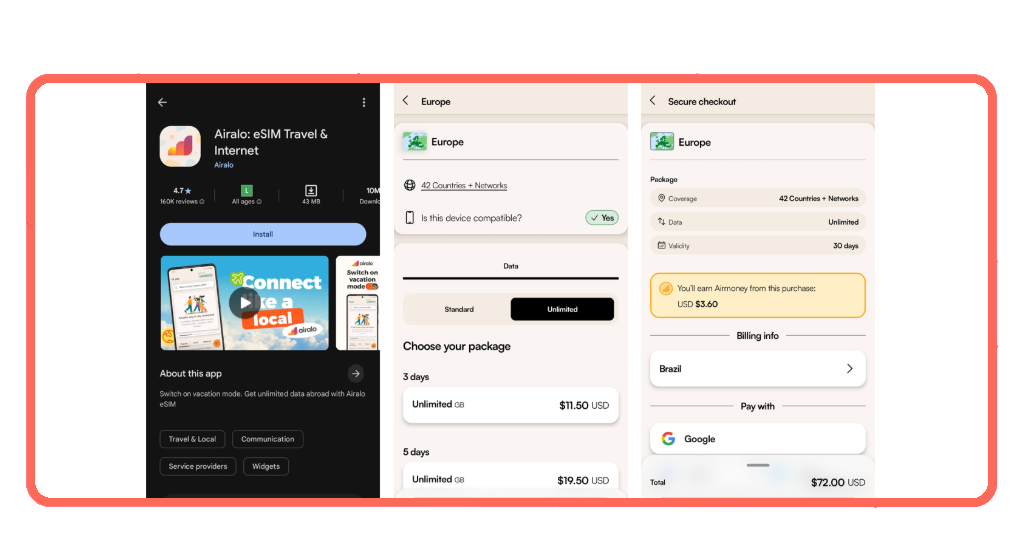
Step 1: purchase a plan inside the app
Download the Airalo app on iOS or Android, create a free account, then search for your destination to see all available plans sorted by data size and validity period.
Once you’ve picked a plan that fits your trip, you complete the purchase inside the app using a card or PayPal, and your eSIM is issued to your account immediately after payment.
Step 2: install the eSIM on your device
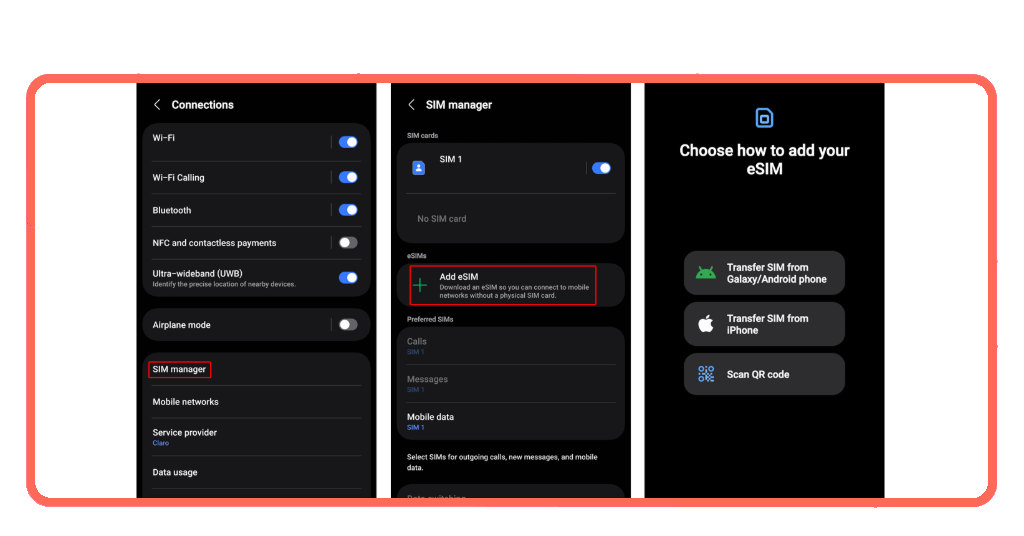
After purchasing, Airalo gives you the option to install the eSIM directly through the app or manually using a QR code, both of which take only a few minutes to complete.
Your phone will add the eSIM as a second line in your phone settings, and you can leave it turned off until you arrive at your destination so it doesn’t activate prematurely.
Step 3: connect to a network on arrival
When you land, go into your phone’s settings, switch your active line to the Airalo eSIM, and your phone will automatically search for a compatible local network at your destination.
A useful thing about keeping your travel eSIM and your home SIM active simultaneously is that you stay reachable on your regular number while browsing on the local data plan.
Travel eSIM, local SIM, or airport Wi-Fi?
There are a few ways to stay connected when you travel, and each one comes with a different set of trade-offs that are worth thinking through before you land somewhere new.
Local SIMs are available in most countries, but buying one means finding a store, dealing with language barriers, and hoping the plan you’re sold actually covers what you need.
Airport Wi-Fi and pocket devices have filled the gap for years, but a travel eSIM removes the need for both by putting a local data connection directly inside your phone.
The airport SIM card trap
Airport SIM vendors know exactly what position you’re in when you land somewhere unfamiliar and need data immediately, and their pricing reflects that advantage in a very deliberate way.
Beyond the inflated cost, you’re also dealing with packaging you can’t read, activation steps that don’t always work, and a customer service number that’s useless once you’ve left the terminal.
Pocket Wi-Fi devices and their trade-offs
A pocket Wi-Fi device gives you a dedicated connection you can share with others, but it also means carrying an extra gadget, remembering to charge it, and returning it before you fly home.
If the device runs out of battery while you’re out, every person relying on it loses connection at the same time, which turns a minor inconvenience into a genuine problem pretty quickly.
One app for every trip you take
Airalo stores all your purchased eSIM plans inside the app, so every trip you take lives in the same place, and pulling up your data plan takes seconds rather than a search through your bag.
Having its travel eSIM also means you’re not starting from scratch each time you go somewhere new, since your account, payment details, and plan history are all already there waiting for you.
Never hunt for airport Wi-Fi ever again
Traveling connected isn’t a luxury anymore; it’s the difference between a trip that flows and one where every little thing requires finding a signal you can’t rely on.
In this Tripiefly guide, we showed what a travel eSIM looks like in practice, how Airalo works, and what sets it apart from the options most travelers default to without thinking twice.
Keep exploring Tripiefly for more articles on international traveling hacks, money-saving tips, and everything else that makes your time abroad easier and a lot more enjoyable.